Oops! Something went wrong while submitting the form.
About one in 50 Australians has a DNA variant that could cause life-threatening disease — and almost none of them know it.
DNA Screen is the world-first Australian screening program that finds these people before disease finds them. In our original pilot study, we tested 10,263 Australians and found 202 people carrying a hidden genetic risk of cancer or heart disease. For every one of them, that result could be the difference between prevention and a diagnosis too late to change the outcome. We know this works. We know it saves lives. And we know it would be cost-effective to do it for every Australian adult.
The only thing missing is the decision to fund it.
Australia already spends big on treating preventable diseases.
● Cancer is the most expensive disease category in the Australian health system, costing $19.7 billion a year, more than any other illness, and a figure that has more than doubled in a decade.¹ ● Cardiovascular disease adds a further $16.9 billion a year to the bill.¹ ● Independent research puts the average health system cost of a single cancer case at roughly $34,000 in the first year after diagnosis alone, and around $50,000 in a patient's final year of life.² ● A genetic test that finds risk before diagnosis costs a few hundred dollars, once, and opens the door to prevention, surveillance, or early treatment that is dramatically cheaper — in dollars and in lives — than treating advanced disease.
Every year population genomic screening is delayed is a year Australia pays the highest price for disease it could have prevented for a fraction of the cost.
¹AIHW, Health Expenditure Australia 2023–24; ²Health services costs for cancer care in Australia estimates, 45 and Up Study (PLoS ONE).
Their stories
They are not people who"should have known." Population screening — testing everyone, not just people who already look high-risk — is the only approach that actually works.
Sam's story: The reassurance that was wrong
Sam's doctors told her, more than once, that her family history wasn't a concern. DNA Screen told a different story: a high-risk BRCA1 variant, carrying a lifetime risk of over 70% for breast cancer and over 40% for ovarian cancer. Sam is now on the pathway to a preventive mastectomy. To those who've suggested that's an extreme step, her answer is blunt: living through breast cancer and chemotherapy is the more dramatic outcome — and it's the one this test lets her avoid. Read more about Sam’s story here.
Amy and Kara's stories
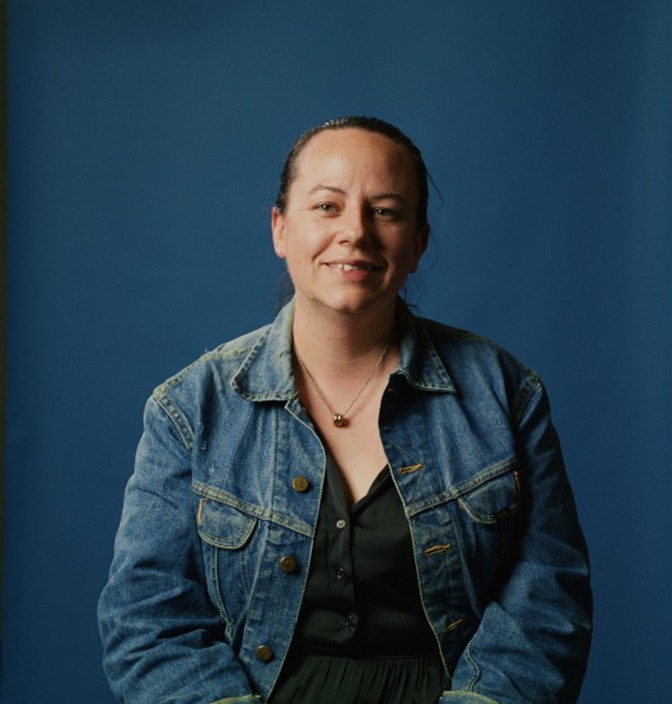
Two DNA Screen participants, each identified as carrying a BRCA2 variant. For Amy, this knowledge informed the treatment of a cancer diagnosed shortly after taking the DNA Screen test; for Kara, this has led her to take measures to drastically reduce her risk.
Eve's story: Lynch syndrome, caught early
Eve carries a Lynch syndrome variant, which sharply raises the risk of bowel and other cancers. Genetic testing gave her, and by extension, her family, since these variants run in families, the chance for early surveillance instead of a late diagnosis.
Atida's story: A second chance most people never get
A BRCA2 carrier identified through a DNA screening study, now able to make informed, preventive decisions about her health that most Australians in her position never get the chance to make because the test was never offered.
Norm's story: The heart attack that never had to happen
Norm carries a familial hypercholesterolaemia (FH) variant — a common, under-diagnosed genetic cause of very high cholesterol and early heart attacks, which is highly treatable once identified. Without the test, Norm's first sign of it could have been a cardiac event with no warning.
These six stories represent 202 people from a pilot of just 10,000. Scaled to the national adult population of over 18 million, the same variant frequency implies well over 200,000 Australians are carrying one of these risks today, undetected. Multiply Sam's story, Norm's story, Eve's story by 200,000 and that is the true scale of what in action currently costs.
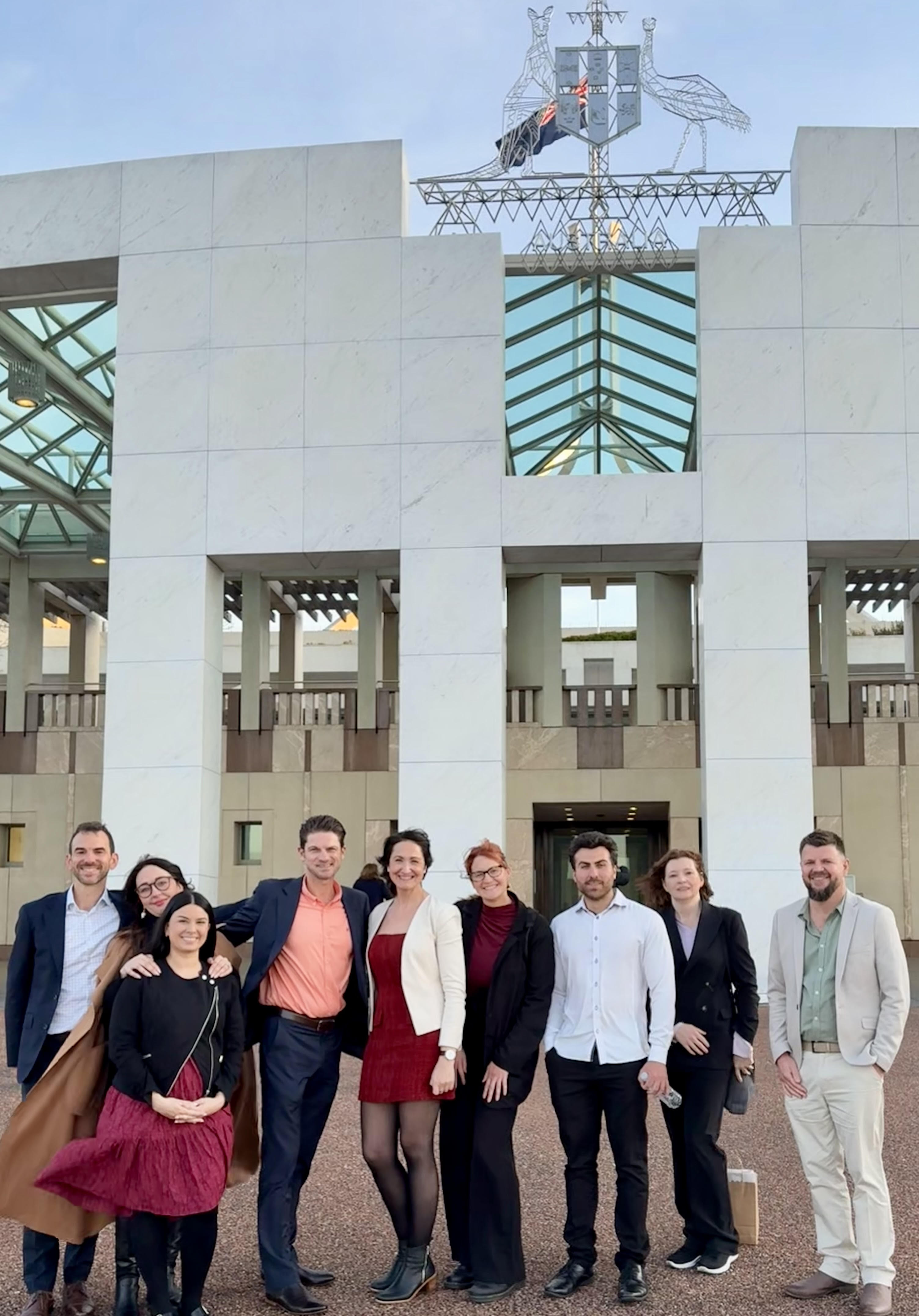
Parliament House, September 2025
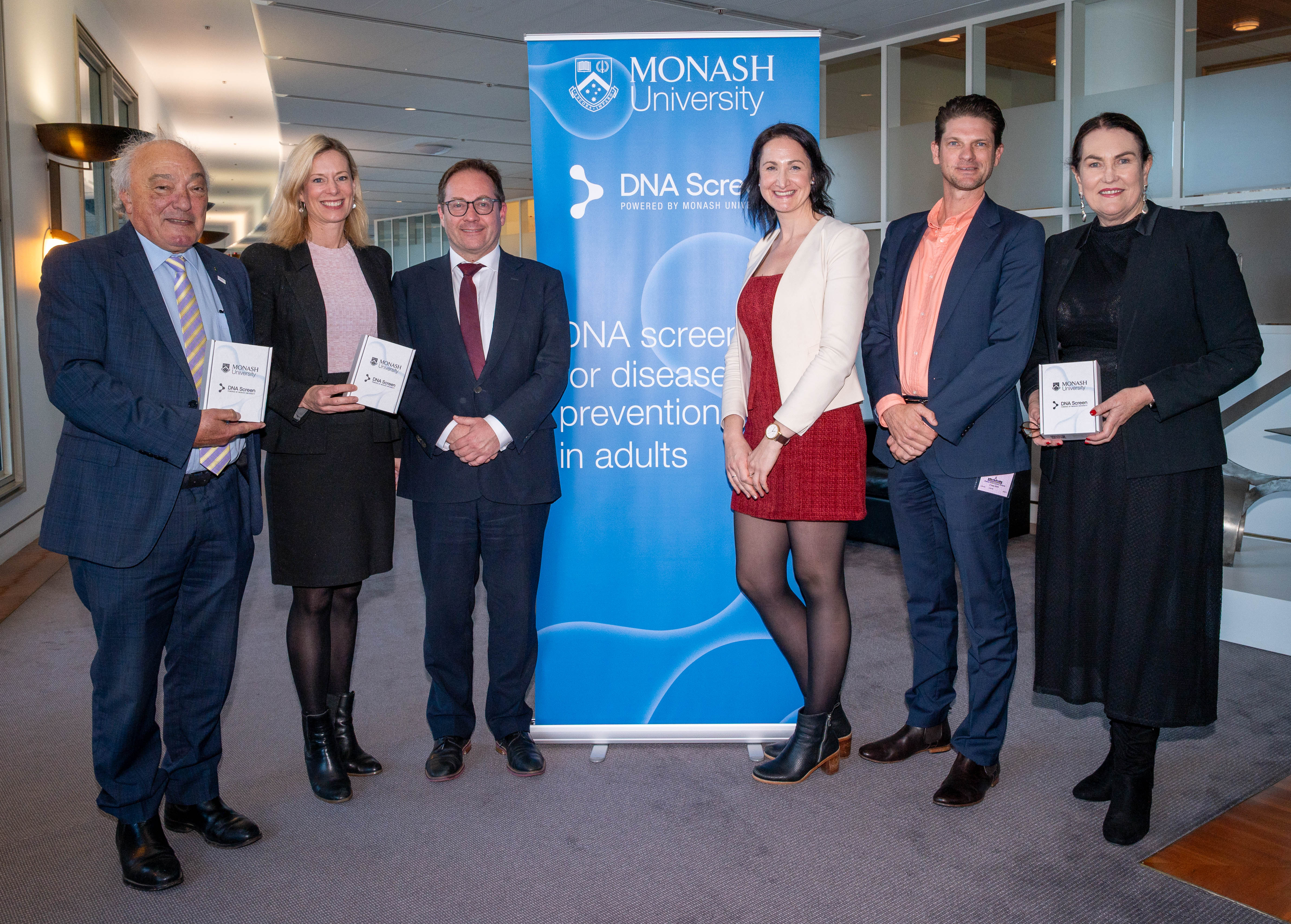
DNA Screen participants and advocates have already taken this case to Australian Parliament House because the people whose lives this program has changed are asking, directly, for it to reach everyone else.
What we're asking government to do
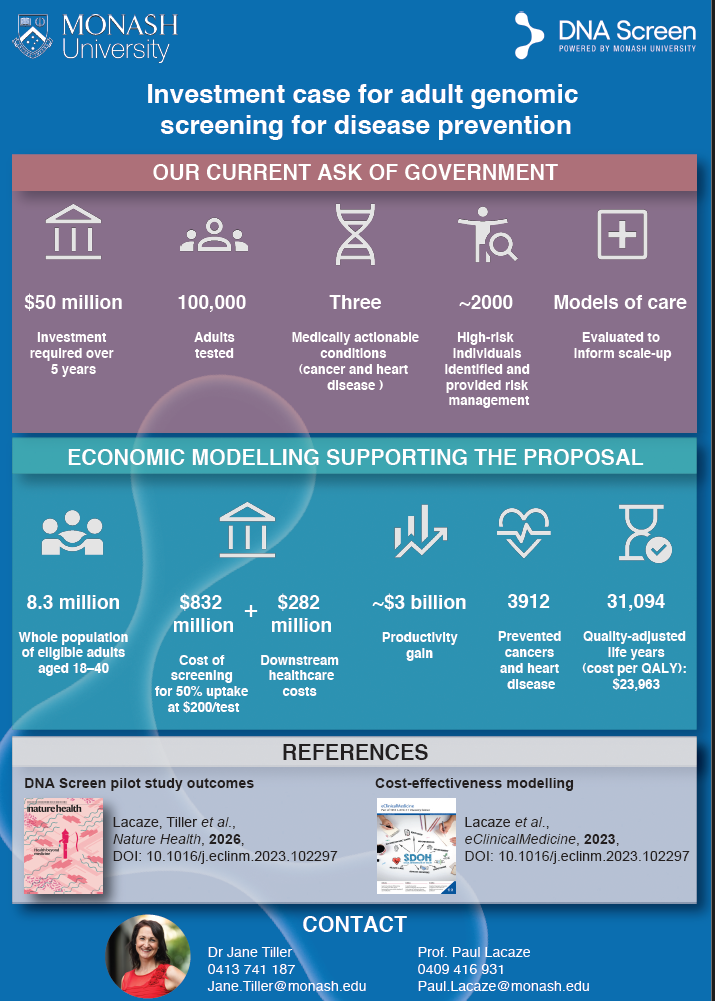
In immediate terms, DNA Screen is asking the Australian Government for one thing: fund the next stage of population genomic screening as public health infrastructure, on the same footing as the bowel, breast and cervical screening programs it already funds. Specifically: 1. Fund the scale-up to 100,000 participants, building directly on a completed, successful, world-first pilot; not a new study, a proven model ready to grow. 2. Commission a formal cost-effectiveness and budget-impact analysis comparing national genomic screening against the current cost of late-stage disease, so the economic case sits alongside the human one in Cabinet.
3. Commit to a pathway to universal access through Medicare, so that every Australian adult, not just those lucky enough to hear about a pilot study, has the chance Sam, Norm, and Eve had.
Every month this decision is deferred, more Australians are diagnosed after the fact rather than protected in advance. This is a solvable problem. Australia has already solved the science. What's left is a decision. Email your Federal MP now using this tool
Participant Information
Check our FAQs for more information about the DNA Screen pilot study.